
Booba and Zoxea Reconnect: How Beat de Boul Helped Shape French Rap
A simple documentary idea was enough to reopen one of the most important chapters in French rap history. After Booba reacted publicly, he and Zoxea reportedly ended up speaking on the phone about Beat…
 Written byZEZ XXI — Mazdak Vafaei Shalmani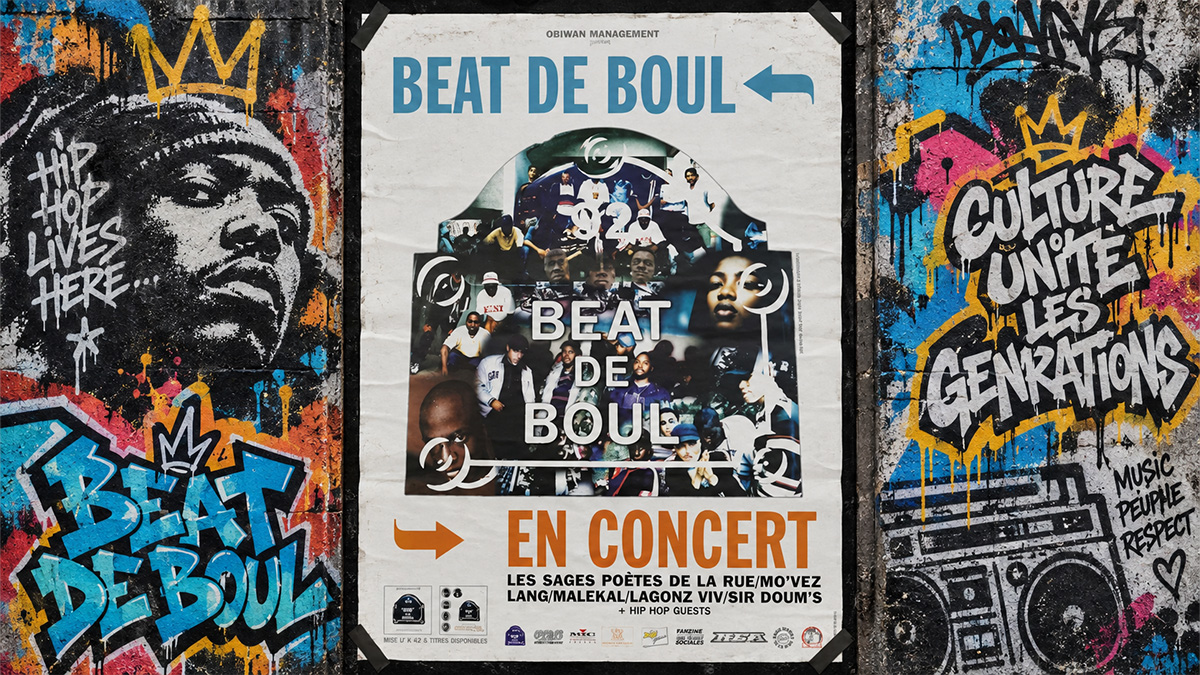
Dans cet article
A simple documentary idea was enough to reopen one of the most important chapters in French rap history. After Booba reacted publicly, he and Zoxea reportedly ended up speaking on the phone about Beat de Boul. Behind this reunion lies the story of a genuine French rap school, born in Pont-de-Sèvres and connected to Lunatic, LIM, Mala and several major figures from the 1990s and 2000s.
It all started with an interview featuring Zoxea and Fif Tobossi, co-founder of Booska-P. The Sages Poètes de la Rue member discussed an idea that has been on his mind for several years: telling the story of Beat de Boul, the collective born in Boulogne-Billancourt in the mid-1990s, through a documentary.
At this stage, the documentary is not officially in production. Zoxea essentially explained that he had already been thinking about the project and had started digging through some of his archives. But the idea quickly caught Booba’s attention. From his perspective, it would obviously be difficult to tell this story without him. Lunatic, the duo he formed with Ali, represents a crucial chapter in the history of Beat de Boul. UNDЯ reported on Booba’s initial reaction.
The exchange eventually appears to have moved beyond social media. According to Generations, Booba and Zoxea spoke on the phone before the rapper posted a message suggesting that the conversation had done him good. More than thirty years after their first collaborations, that phone call has brought one of French rap’s most significant — and turbulent — relationships back into the spotlight.
Before Booba, there were the Sages Poètes de la Rue
To understand Beat de Boul, you first have to go back to Pont-de-Sèvres, in Boulogne-Billancourt.
In the early 1990s, a scene began developing around Zoxea, Melopheelo and Dany Dan, the future members of Sages Poètes de la Rue. The trio notably appeared on Jimmy Jay’s Cool Sessions before releasing their debut album, Qu’est-ce qui fait marcher les sages ?, in 1995. Radio Nova revisited the group’s beginnings and this foundational period.
Hip-hop was already circulating in the neighborhood even before the Sages emerged. Zoxea has cited older figures such as Ben-K and Les Sans Tiep’, who helped introduce a younger generation to records, clothing styles and influences from both American and British rap. Zoxea recounts this early history of rap in Boulogne in an extensive interview with L’Abcdr du Son.
At a time when Boulogne was rarely associated with the imagery of French rap, the Sages helped establish the 92 department as a musical territory in its own right. Pont-de-Sèvres offered a striking contrast with Boulogne-Billancourt’s wealthy reputation: the neighborhood was a working-class housing estate in a city historically shaped by the former Renault factories.
Local families themselves were closely connected to that industrial history. Zoxea and Melopheelo’s parents both worked for Renault, whose Billancourt factory permanently closed in 1992. Radio Nova has highlighted this working-class background.
That geography would prove essential. A growing number of young rappers gravitated around the Sages, meeting up, writing, freestyling and improving together.
In 1995, this creative energy was given a name: Beat de Boulogne, soon shortened to Beat de Boul. Zoxea says he came up with the name as part of an effort to bring together the neighborhood’s different talents. He describes the birth of the collective in his interview with L’Abcdr du Son.
Beat de Boul was more than just a collective
Looking back, Beat de Boul is sometimes reduced to a list of famous rappers who happened to share the same banner. That understates what it really represented.
Years later, Melopheelo would describe it as a genuine school. MCs gathered at the foot of the apartment blocks, formed circles, traded rhymes and sharpened their technique. The Sages Poètes would then identify the most promising rappers, push them to improve and give them access to recording opportunities. Melopheelo and the Sages discussed this way of working at length.
That environment included Malekal Morte, featuring Mala, Bram’s and Issaka, Mo’Vez Lang with LIM, Cens Nino and Boulox, Sir Doum’s, as well as Lunatic, the duo formed by Booba and Ali.
Mala himself has never downplayed Zoxea’s importance to that generation. Years later, he explained that the Sages Poètes rapper had genuinely taught him how to rap, and argued that the stories of both Malekal Morte and Mo’Vez Lang originated in the work done by Zoxea and the Sages. Mala discussed Zoxea’s role as a mentor in his interview with Le Bon Son.
Beat de Boul therefore operated less like a modern record label and more like a grassroots incubator for Boulogne’s rap scene.
When Booba and Ali joined the Beat de Boul circle
Before becoming the self-styled “Duc de Boulogne,” Booba was first a dancer and spent time around the La Cliqua scene. He eventually formed Lunatic with Ali and gradually became part of the wider Boulogne rap movement.
Zoxea later recalled that Booba and Ali were already rapping when they came into the Beat de Boul circle, but they were still young and received little recognition. Zoxea, however, immediately saw their potential. He would later explain that Booba’s eventual trajectory did not surprise him.
Lunatic began working with the Sages Poètes.
And the relationship went far beyond a handful of freestyles.
After completing their own debut album, the Sages began working on an early Lunatic project that later became known as Sortis de l’ombre. The record was made under very DIY conditions, including sessions at Zoxea’s home, with the aim of recreating the rawness of New York rap at the time. The Sages Poètes have described the recording conditions of the project in detail.
The album was never released.
The lost album that could have changed Lunatic’s history
The split between Lunatic and the Sages has generated plenty of mythology over the years.
Melopheelo’s account, however, helps reconstruct much of what happened. After hearing some Lunatic tracks reworked in professional studios for the Cool Sessions, Booba and Ali reportedly wanted to redo the entire album with a higher standard of mixing and production.
The Sages Poètes disagreed.
For them, the raw quality of the recordings was precisely what gave the project its identity. Melopheelo therefore describes the initial split as an artistic disagreement over sound and mixing, before the relationship deteriorated further afterwards. This version of events is detailed in the Sages Poètes de la Rue interview.
Booba himself later gave a broadly similar account of that period: the duo liked the project but wanted to upgrade the sound after discovering more professional recording conditions. An older Lunatic profile preserved by Africultures revisits this stage of the duo’s career.
Lunatic subsequently left the Beat de Boul environment and moved closer to Time Bomb, another crucial laboratory of 1990s French rap, where they crossed paths with artists including Oxmo Puccino and X-Men.
What happened next became part of French rap history. Booba’s career would later go through several other decisive — and sometimes forgotten — episodes, including the Studio 287 affair that could have dramatically changed his career.
But even one of Lunatic’s most important tracks still carries a direct trace of the Beat de Boul era.
Even “Le Crime paie” has roots in Beat de Boul
Years later, when discussing “Le Crime paie”, Booba himself recalled that several versions existed before the track that was ultimately released.
One of them had been produced by Zoxea, who also performed the chorus.
The concept of the song was kept, while the instrumental evolved before reaching the version that eventually became famous. Booba himself discussed this early Zoxea-produced version with L’Abcdr du Son.
Melopheelo has also explained that this early version was among the recordings from the Beat de Boul period and that, although some tapes from the era were later recovered, this particular version of the song has never resurfaced. His account complements Booba’s own recollection.
The detail is far from insignificant.
“Le Crime paie” would become one of the defining tracks in the Lunatic legend. In other words, part of the DNA of the song that helped establish Booba and Ali in French rap was developed during their time around Beat de Boul.
Booba’s story obviously did not begin with Zoxea. But a crucial part of his development as a rapper belongs to this Boulogne school.
“Dans la Sono” finally put Beat de Boul on record
Paradoxically, Lunatic had already left by the time Beat de Boul released its first genuine collective project.
In 1997, Dans la Sono brought together the Sages Poètes, Malekal Morte, Mo’Vez Lang, Sir Doum’s and other representatives of the Boulogne scene.
Seven tracks were enough to document a school whose influence already extended far beyond its actual discography. L’Abcdr du Son lists the project in its chronology of French rap in 1997.
In 2000, Dans la Ville continued the story and captured another stage in the evolution of this generation. Around the Sages, different artists from the 92 kept alive a particular approach to rap: an emphasis on technique, a love of freestyling, meticulous attention to flow and a permanent sense of competition between MCs.
This identity would prove strong enough for the expression “the Boulogne school” to outlive the collective itself. Mouv’ later devoted an entire feature to Beat de Boul’s legacy.
A breeding ground whose artists would follow very different paths
This is probably what makes Beat de Boul so unusual.
The collective never achieved the recording longevity its line-up might have suggested. Yet many of its members — and artists who passed through its orbit — would go on to occupy major positions in French rap.
Booba would build one of the most significant careers in the history of French rap. His evolution cannot be measured through sales or changing production styles alone: UrbanTrackz has also analyzed the evolution of Booba’s vocabulary across 200 songs, providing another way of tracking how his writing changed over the years.
LIM would become a major figure in independent and street rap during the 2000s.
Mala would remain one of Booba’s historic long-time associates.
Dany Dan, Zoxea and Melopheelo would each retain a special status among listeners who value technical skill and writing.
Zoxea’s approach to identifying and mentoring new artists would also survive Beat de Boul itself. The Sages would go on to work with much younger generations, eventually crossing paths with artists such as MZ. L’Abcdr du Son once brought the Sages Poètes and MZ together to discuss this transmission between generations.
The commercial success of some and the more underground careers of others eventually obscured what they all shared: the same geographical and artistic foundation.
Booba and Zoxea: more than an old feud
The relationship between Booba and Zoxea did not remain limited to a disagreement over mixing.
The two men went through a long period of tension, including an altercation that became part of Boulogne rap folklore. At the same time, each developed his own claim to the city: Zoxea was sometimes presented as the “King of Boulogne,” while Booba gradually turned “Boulbi” and his “Duc de Boulogne” persona into central elements of his artistic identity. Booska-P has revisited both those tensions and Booba’s Boulogne history.
Booba’s influence would later extend far beyond Boulogne and intersect with several generations of French rap, all the way into the 2010s and 2020s. Some figures from his wider circle would even take on an almost mythological status, including the mysterious “Madrina” associated with Booba and Maes.
That is precisely why their recent conversation carries a different kind of weight.
This is not simply a case of two veteran rappers putting an old dispute behind them.
Booba and Zoxea each hold a different part of the memory of that era.
Zoxea was one of the people who organized and transmitted this school. Booba was the artist who passed through it and went on to achieve the most spectacular career.
Telling the story of Beat de Boul without either of them would inevitably leave part of the puzzle missing.
A documentary that would be about much more than nostalgia
There is still no confirmation that a Beat de Boul documentary will actually be made. For now, it remains an idea raised by Zoxea and subsequently revived by Booba’s reactions and their recent conversation. Generations reported on their recent rapprochement.
But the value of such a project would be obvious.
Before labels became empires, before certifications were counted in the hundreds of thousands and before French rap became one of the country’s dominant forms of music, there was a generation of rappers in Pont-de-Sèvres learning their craft in circles at the foot of the apartment blocks.
Directly or indirectly, some of the artists who would profoundly transform French rap emerged from that school.
Thirty years later, the conversation between Booba and Zoxea is a reminder of something that the scale of Booba’s individual success has sometimes obscured:
before 92i, before Time Bomb and before Booba’s solo career, there was already Beat de Boul.