
Jewel Usain delivers a controlled finale with “Fou”
Jewel Usain continues to evolve artistically with the release of "Otoko", a four-track EP driven by a strong visual identity and a carefully crafted artistic direction. Conceived as the extension of an initiatory journey…
 Written byZEZ XXI — Mazdak Vafaei Shalmani
Dans cet article
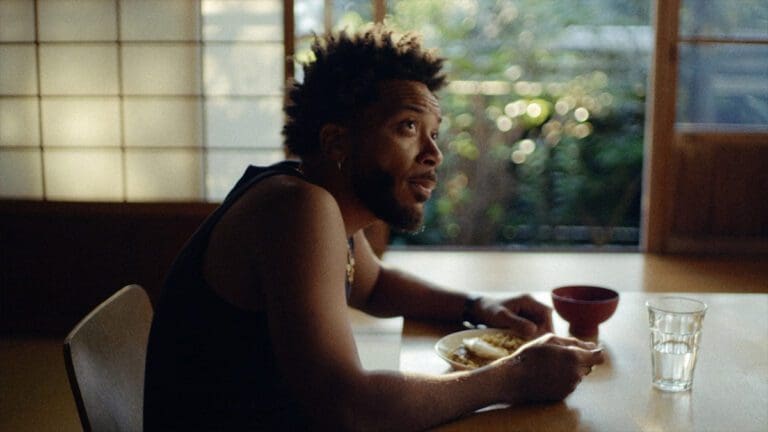
Jewel Usain continues to evolve artistically with the release of “Otoko”, a four-track EP driven by a strong visual identity and a carefully crafted artistic direction. Conceived as the extension of an initiatory journey to Japan, the project marks a pivotal moment in his career, sitting somewhere between two albums. A transition the artist himself hints at through these lines: “J’suis sur l’deuxième album et j’sens qu’j’ai la dalle / J’aime plus cet appart’, faut changer la taille / J’dirige ce truc comme un cadre”. To bring this vision to life, Jewel Usain teams up with Béesau on production and Kidhao on direction, forming a tight creative trio. Together, they deliver a hybrid piece, somewhere between a music video and a short film, carried by a bold aesthetic and a deliberately fragmented narrative.
The project’s backbone lies in the artistic transformation undertaken by Jewel Usain, with this journey acting as the catalyst for a renewed creative approach. Previously, with “Où les garçons grandissent”, the rapper had already presented a cohesive body of work, structured with a clear progression from track to track. This approach echoes a certain old-school tradition in album crafting. However, far from confining himself to a single style, Jewel Usain moves fluidly across different hip-hop aesthetics, asserting a rare level of artistic freedom. With the visual for “Fou”, the final chapter of “Otoko”, he brings this cycle to a close while subtly setting the stage for what comes next.
Jewel Usain delivers a controlled finale with “Fou”
This track fully embodies the collaborative dynamic at the heart of the project. Jewel Usain entrusts the composition to Béesau, a long-time collaborator and a key sonic architect of the EP. The production unfolds with an immersive atmosphere, carefully crafted while avoiding the clichés of overly predictable cloud aesthetics. The rhythm remains both controlled and impactful, while vocal textures add an almost aerial dimension to the track. Béesau, who has also worked with Disiz and Leo Middea, further demonstrates his strong connection with Jewel Usain’s universe. Staying true to his artistic identity—less focused on ego-driven rap and deeply rooted in hip-hop fundamentals—the rapper delivers sharp, incisive lines:
“They always thought they were the best ’cause they only rap among themselves
I don’t even read comments like that anymore
Anyway, it’s been a long time since I stopped watching when the plane takes off”
Directed by Kidhao in Japan, the video shifts the focus back onto Jewel Usain himself, unlike “Ikebukuro”, which leaned more toward a narrative, short-film approach and was less centered on the artist. Here, the visuals serve to highlight his presence and artistic evolution. Kidhao once again showcases his consistency behind the camera, having recently delivered standout visuals such as “Bordel” for Kekra and “Merci” for SDM, along with multiple projects for Jewel Usain.
