
Gazo and La Mano 1.9 in Kraken: French Rap Meets Horror
On paper, Kraken could almost look like a particularly well-designed marketing move: take Gazo and La Mano 1.9, two of the most prominent rappers of their generation, put them in front of a movie…
 Written byZEZ XXI — Mazdak Vafaei Shalmani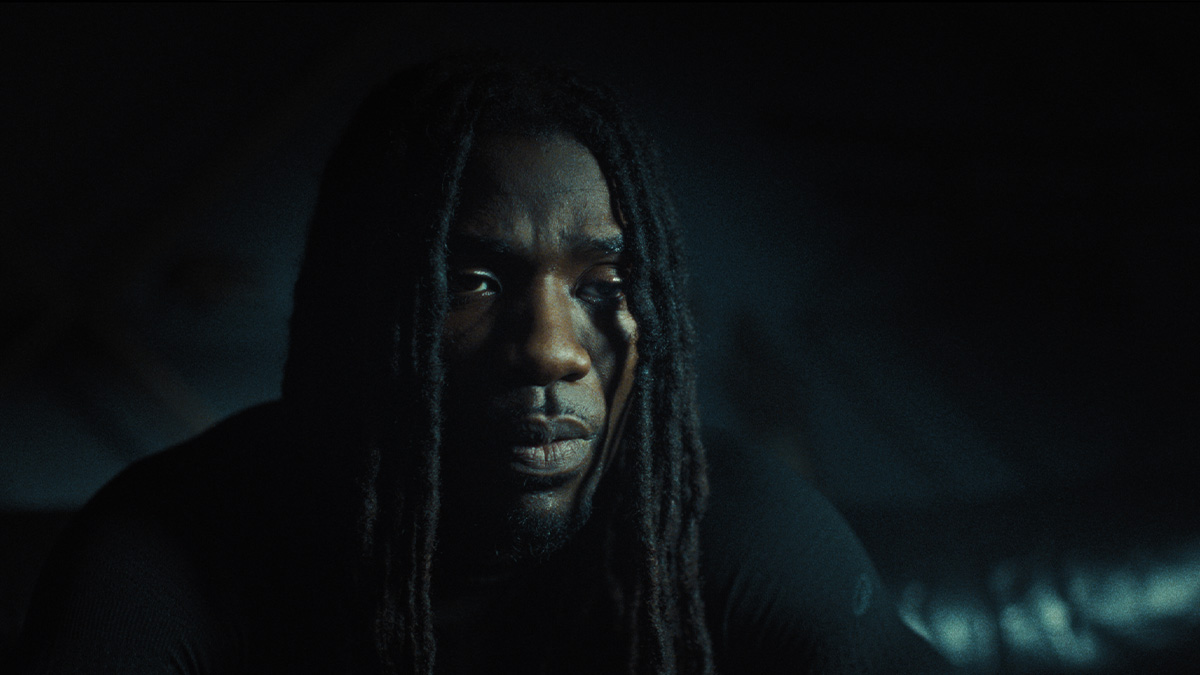
On paper, Kraken could almost look like a particularly well-designed marketing move: take Gazo and La Mano 1.9, two of the most prominent rappers of their generation, put them in front of a movie camera for the first time, and lock them inside a housing estate with a killer.
But the feature-film debut of Mohamed Chabane and Théo Jourdain Rhodes appears to have something far more interesting to say. Beneath the gore, the slasher mechanics and the presence of two major French rap stars, Kraken primarily uses horror to shift the way the housing projects are usually portrayed and to smuggle in, almost under the radar, a form of social criticism.
Distributed by PAN Distribution, the film will be released in France on September 30, 2026. Running 95 minutes and rated for audiences aged 16 and over, it also stars Alassane Diong, Manon Bresch, Guillaume Gouix, Bilel Chegrani and Lucie Charles-Alfred.
An abandoned tower block in the middle of the projects
The premise is deliberately simple. In a housing estate, an abandoned tower block has long been surrounded by rumors. People begin disappearing, and five young people are forced to go back inside. Once they enter the building, they find themselves caught in a trap from which there seems to be no escape.
The neighborhood is therefore not merely the film’s setting. It practically becomes a character in its own right. Kraken was shot in La Grande Borne, Grigny, whose distinctive architecture — particularly its blue apartment blocks — Mohamed Chabane and Théo Jourdain Rhodes wanted to use visually. The location carries an additional significance: Bilel Chegrani had shot his first short film in the same housing estate ten years earlier, according to information gathered by AlloCiné from the directors.
This may be where Kraken reveals its first genuinely distinctive quality. For decades, France’s working-class suburbs and housing projects have largely served as the backdrop for social dramas, crime films, drug stories or narratives about relations with the police. Here, the codes are reversed: the housing block becomes the haunted house, and the estate’s corridors become those of a slasher movie.
“Sheitan,” “The Horde,” “Vermines”: Kraken did not come out of nowhere
Kraken is not, however, the first French film to bring together rap, working-class neighborhoods and horror cinema.
In 2006, Kim Chapiron, who emerged from the Kourtrajmé collective, directed Sheitan starring Vincent Cassel. Several figures closely associated with hip-hop culture appeared in the film: Oxmo Puccino plays a nightclub customer, Mokobé a bouncer, while Mouloud Achour appears as the DJ at the Stixx Club. The film’s cast already reflected the close relationship between French genre cinema and rap culture.
A few years later, Yannick Dahan and Benjamin Rocher’s The Horde turned a housing tower into a battlefield overrun by zombies. Rapper Doudou Masta played Bola, one of the film’s key characters. Once again, horror was being brought directly into the urban housing-estate environment.
But the clearest recent precedent is probably Vermines, directed by Sébastien Vaniček in 2023. The filmmaker trapped the residents of a suburban apartment building with an infestation of deadly spiders and openly embraced the film’s political subtext. In an interview with Le Monde, Vaniček explained that he wanted to address the frustration experienced by a young man from the suburbs, drawing a parallel between trapped animals and the way some residents of working-class neighborhoods are themselves treated as “vermin.”
Speaking to Cineuropa, he summed up the appeal of the approach perfectly: horror allowed him to deal with serious political themes while still reaching a much broader audience.
Kraken therefore belongs to a small but established French tradition. Yet it adds another element: two of the biggest rappers on the current scene are making their big-screen debuts at the same time.
Gazo and La Mano 1.9 go from music videos to the big screen
Gazo and La Mano 1.9 obviously did not meet for the first time through Kraken. The two artists had already crossed paths on “Pop!”, released in 2024 and produced by SHK and ALX. The English-language coverage of the track can also be found on Hellsinky.
This time, however, they are moving into an entirely different medium. According to the directors, the production was primarily looking for performers with a natural screen presence, with the authenticity of series such as Top Boy serving as a reference point. For both Gazo and La Mano 1.9, Kraken marks their first role in a feature film.
Mohamed Chabane has also spoken about Gazo’s physical commitment during the shoot, including particularly uncomfortable scenes filmed in the middle of winter. The rapper appears to have fully embraced the physical demands of the genre without trying to protect his established image.
The transition is not entirely surprising. Gazo’s music videos have long relied on highly polished visual direction. UrbanTrackz previously published a feature on the beatmakers and directors shaping his visual universe. On Hellsinky, the video for “Probation” was already described as something close to a short film.

Before Kraken, Snoop Dogg had already turned the hood into a haunted house
In the United States, the relationship between rap and horror goes much further back — and has always been far more openly embraced.
By the late 1990s, Ice Cube had appeared in Anaconda, LL Cool J in Halloween H20, and rappers were increasingly finding their way into horror movies. But around the turn of the millennium, the phenomenon became something close to a subgenre of its own.
The documentary Horror Noire, which explores the history of Black representation in American horror cinema, identifies this period as the moment when a wave of horror films directly influenced by hip-hop began to emerge. The connection made sense: horrorcore and other strands of American rap had already spent years borrowing macabre imagery, supernatural themes, violence and the visual language of horror movies.
One of the clearest examples of that crossover is Bones, directed by Ernest Dickerson in 2001 and starring Snoop Dogg.
Snoop plays Jimmy Bones, a respected figure in his neighborhood during the 1970s. Though involved in illegal gambling, Bones is portrayed as a protector of the community and refuses to allow drugs to destroy the neighborhood. He is eventually betrayed and murdered. More than twenty years later, with the area having fallen into decline, a group of young people decide to turn his abandoned house into a nightclub. In doing so, they unwittingly awaken his spirit, and Bones returns from the dead to take revenge on those responsible for his murder.
The official synopsis currently available on Starz similarly describes the character as a murdered “neighborhood protector” who returns from the grave.
But Bones is not simply a movie that drops Snoop Dogg into a haunted house. Even when the film was released, some critics noted its social dimension: the decline of the neighborhood, the arrival of drugs, and the gap between the generation that lived through that history and younger people who inherit the codes of the hood without necessarily knowing its memory.
In Horror Noire, the film is cited as one of the defining examples of hip-hop-inflected horror in the early 2000s, built around a central idea: horror can also be used to tell the story of what happened to Black neighborhoods in America.
Has genre cinema become one of the last refuges of social criticism?
This is where Kraken becomes more interesting than its promotional hook might suggest.
Since the 1990s, the line separating American independent cinema from the Hollywood studio system has become increasingly blurred. Disney’s acquisition of Miramax in 1993 became one of the defining symbols of that shift. Film scholars even began using the term “Indiewood” to describe productions occupying the space between independent filmmaking and the industrial logic of the major studios.
The academic study Indie, Inc.: Miramax and the Transformation of Hollywood in the 1990s examines precisely this transformation. In 2004, The Guardian similarly observed that the success of Miramax and films such as Pulp Fiction had encouraged virtually every major studio to develop its own “independent” division.
It would be an exaggeration to argue that American independent cinema lost all of its critical edge. But some of the most provocative social commentary increasingly found fertile ground in a less obvious space: genre cinema.
Antoine de Caunes has regularly explored the ability of popular genres to reflect their times in his Canal+ series Genre Genres, covering everything from zombie movies and westerns to science fiction and war films.
One of the clearest examples, however, remains The Purge.
“The Purge”: smuggling politics into a horror movie
The premise of The Purge initially sounds like a perfect piece of high-concept exploitation cinema: for one night, every crime in the United States, including murder, becomes legal.
But creator James DeMonaco has never hidden what lies beneath the spectacle. In an interview with Den of Geek, he explained that the film was also about the divide between rich and poor, gun culture and race. More importantly, he used a particularly revealing phrase: “smuggler’s cinema.”
“Let’s do a genre movie. We can smuggle some stuff in there.”
James DeMonaco, Den of Geek
In other words: make an effective, accessible piece of entertainment first, then smuggle political and social ideas inside it without turning the film into an overt manifesto.
Genre cinema has been doing exactly that for decades. George A. Romero could use the zombies of Dawn of the Dead to explore consumer culture. Jordan Peele could turn the nightmare of Get Out into an examination of American racism. Sébastien Vaniček could turn the spiders of Vermines into a metaphor for the way people from the suburbs are viewed.
And Kraken appears to be using the same mechanism.
In Kraken, the monster is a police officer
Because perhaps the most important detail in the film is neither Gazo, nor La Mano 1.9, nor even the abandoned tower.
It is the identity of the killer.
While developing their antagonist, Mohamed Chabane and Théo Jourdain Rhodes considered several possibilities: a former soldier who had lost his mind, or even a former child soldier. In the end, they chose something much more directly rooted in contemporary French reality: a police officer who snaps and becomes the slasher’s killer.
“A cop who has snapped… who kills guys, and we take all the police brutality cases and turn them into a horror movie.”
Théo Jourdain Rhodes, quoted by AlloCiné
That decision immediately created another writing constraint: if the murderer is a police officer, then his weapons also need to belong to that world. The filmmakers therefore built certain sequences around a Taser and stun grenades, transforming standard police equipment into the tools of a horror movie.
The choice is far from insignificant.
In the traditional American slasher, the police officer usually arrives to stop the monster, protect the victims or survey the aftermath. In Kraken, the figure who is supposed to represent law and order becomes the threat itself. And those trying to escape him are young people trapped inside a housing tower.
The architecture, the weapons, the uniform, the relationship between young people and the police: everything that would normally belong to the vocabulary of French social-realist cinema is transferred into the language of horror.

Directors who were already interested in society
The choice feels even less accidental when you look at the filmmakers’ previous work.
Before Kraken, Mohamed Chabane and Théo Jourdain Rhodes had notably worked together on ReuSSS for France TV Slash, a musical series blending rap, R&B and social drama. France Télévisions said at the time that the show sought to portray contemporary France in all its diversity while addressing racism, sexism, extremism and intolerance.
The series won the Prix Révélation Réalisation at the 2023 Éclats awards, while its three lead actresses received a collective acting prize at Séries Mania. The two directors later worked on the final three episodes of Young Millionaires for Netflix.
In other words, neither urban culture, the housing projects nor the idea of using a popular genre to say something beyond what is immediately visible on screen is new territory for them.
Kraken may be a lot smarter than it looks
Of course, we will have to see the film in full before knowing how far this dimension is actually developed. An interesting subtext does not automatically make a good movie, and Kraken is still being marketed first and foremost as a horror spectacle.
But reducing the project to “Gazo and La Mano are starring in a horror movie” would mean overlooking precisely what could make it interesting.
Just as Bones turned the American hood and its history with drugs into a haunted house, just as The Purge turns the fractures of American society into a blood-soaked dystopia, and just as Vermines used spiders to explore the way the suburbs are viewed, Kraken takes the codes of the slasher and relocates them to a distinctly French environment.
A housing estate. A tower block. Young people. A police officer. A Taser. Stun grenades. Then horror cinema slightly distorts each of those elements until it makes visible something that, in reality, is already a source of fear.
In short, “Kraken” may be a lot smarter than it looks.
