
AI Is About to Do to Cinema What the Home Studio Did to Music
Making a track from your bedroom has become commonplace. Making a film could soon be just as accessible. Following the first revolution brought about by digital technology, artificial intelligence is now beginning to tear…
 Written byZEZ XXI — Mazdak Vafaei Shalmani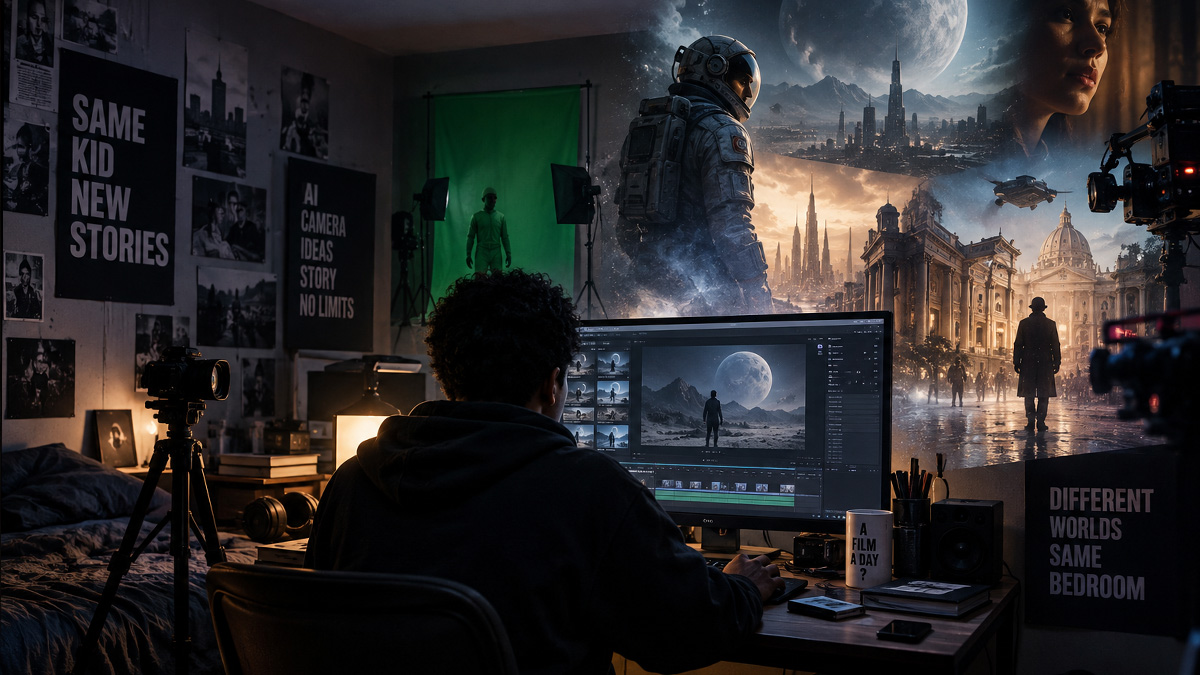
Making a track from your bedroom has become commonplace. Making a film could soon be just as accessible. Following the first revolution brought about by digital technology, artificial intelligence is now beginning to tear down some of the last economic barriers to filmmaking. This new wave of democratization could empower an entire generation of creators — but it could also trigger the same kind of saturation we have already seen in music.
For most of its history, cinema has been an art form heavily dependent on money. You could write a novel alone, paint a picture alone and, eventually, record a song alone. But making a feature film without cameras, technicians, actors, lighting, sets, costumes, sound engineers, editors, visual effects and, above all, financing was another matter entirely.
Artificial intelligence could be about to blow that model apart.
By 2026, the phenomenon had become significant enough for the future of cinema in the face of AI and digital platforms to take center stage at the Lumière Summit, held in France and attended by representatives from across the international film industry. Artificial intelligence, competition from social media, film financing and the challenge of winning audiences back were among the major issues being discussed.
Before AI, digital technology had already begun tearing down cinema’s walls
The democratization of filmmaking did not begin with Midjourney, Veo, Runway or other generative tools.
The first major revolution had already taken place in the late 1990s and early 2000s with the arrival of DV cameras, followed by increasingly affordable digital cameras and computer-based editing software.
As early as 1999, Filmmaker Magazine noted that a consumer DV camera could cost between $1,000 and $2,000, while a so-called “prosumer” camera capable of being used to shoot a feature film could be bought for between $2,000 and $4,000. Films such as Festen, directed by Thomas Vinterberg, demonstrated that filmmakers no longer necessarily needed the traditional technical infrastructure of the movie industry to make a film.
The revolution was not limited to cameras. Non-linear computer editing gradually eliminated the need for prohibitively expensive post-production equipment. Then the internet began solving another major problem: distribution.
For the first time, a filmmaker could shoot, edit and show their work without necessarily passing through all the traditional gatekeepers of the industry.
MiniDV, then DSLRs, smartphones, YouTube, affordable software and eventually social media gradually narrowed the technological gap between amateurs and professionals.
But one major barrier remained.
You could buy a camera for a few hundred or a few thousand dollars. But you still couldn’t recreate a battle involving 5,000 extras, blow up a building, shoot a scene on Mars or reconstruct 1920s Paris from your bedroom.
That is precisely the last frontier AI is now beginning to challenge.
A feature film for $2,000
Perhaps the most striking example is Dreams of Violets.
In June 2026, Ash Koosha‘s 75-minute film became the first fully AI-generated feature to enter the main program of a major film festival, Tribeca. Its reported cost: approximately $2,000.
Koosha himself has described the economic upheaval behind the project: images that could have required millions of dollars’ worth of traditional CGI were produced for just a few thousand dollars. He has also spoken about his interest in making films almost at the speed of current events.
That represents a fundamental shift.
Because AI is not simply making the camera cheaper. It is beginning to reduce the cost of what appears in front of the camera — and what happens after the camera stops rolling.
Sets, extras, creatures, animation, dubbing, previsualization, certain visual effects, retouching, voices and temporary music: an increasing part of the filmmaking process can now be generated or assisted by AI.
In August, the new studio Promise, backed in part by Silicon Valley investors, was already working on hybrid productions combining real actors with AI-generated environments. Its co-founder George Strompolos estimates that this kind of production could cost 20 to 50% less than a conventional shoot.
It is essentially the home-studio revolution applied to cinema.
“I can make a short film for $500”
This new generation of filmmakers is not simply talking about cutting costs. It is talking openly about removing the gatekeepers.
Filmmaker Victoria Heenan, discussing her use of AI, summed up the change in simple terms:
“I can make a short film for $500.”
For her, the point is that creators should no longer have to wait for Hollywood to let them into the industry before they are able to tell their stories.
This is where the comparison with music becomes particularly relevant.
For decades, making a record also required infrastructure: a studio, a mixing console, expensive equipment, a sound engineer, sometimes musicians, and then a label capable of manufacturing and physically distributing the record.
The home studio gradually broke down that barrier.
Then digital distribution and streaming broke down the next one.
Today, a teenager can produce a track on a laptop at night and distribute it worldwide just days later.
The music industry did not disappear. Its bottleneck simply moved somewhere else.
The question is no longer primarily: “How do I record my song?”
It has become: “How do I get anyone to hear it?”
Cinema could be heading toward exactly the same transformation.
Democratization also produces a lot of bad content
Open Instagram, TikTok or any number of specialized apps and one thing quickly becomes obvious: democratization does not automatically mean improvement.
Over the past few years, a new market has exploded: vertical micro-dramas.
Some are essentially feature-length narratives chopped into dozens of one- or two-minute episodes, each built around a constant stream of cliffhangers: adultery, mysterious billionaires, revenge, inheritance, arranged marriages, crime and betrayal.
Companies and small studios churn these series out at remarkable speed, then distribute clips across social media to funnel viewers toward their apps.
The quality varies enormously, and much of this output can feel like cinema produced on an assembly line: questionable acting, rudimentary lighting, mechanical dialogue, repetitive plots and editing designed above all to stop viewers from swiping away.
Economically, however, the phenomenon is anything but insignificant.
Deloitte estimated global in-app revenues from micro-series at approximately $3.8 billion in 2025 and predicted they could reach $7.8 billion in 2026. Apps such as DramaBox, ReelShort, ShortMax and DramaWave have already turned the aesthetic of the “cheap vertical soap opera” into a genuine industry.
That may offer an early warning of what AI could bring.
Because if mediocre content is already cheap to produce, producing 100 mediocre pieces of content with AI will be cheaper still.
When production costs approach zero, output explodes
Once again, music provides an almost perfect case study.
The democratization of music production has been extraordinary.
It has allowed artists who might never have made it through the doors of a record label to produce their own music, build their own audiences and, in some cases, become international stars.
Rap in particular has been completely transformed by this shift.
But that freedom has a downside: an extraordinary explosion in the sheer volume of music being released.
According to Luminate data reported in 2026, around 106,000 new tracks per day were delivered to streaming services in 2025. The catalog being tracked had grown to roughly 253 million tracks. Nearly half of them — 120.5 million — received ten streams or fewer over the entire year.
In other words, we have moved from an economy in which making music was difficult to one in which we produce far more music than human beings could ever possibly listen to.
AI is now accelerating that phenomenon even further.
In July 2026, Deezer reported receiving around 90,000 fully AI-generated tracks every day. At peaks recorded in June, they accounted for more than 50% of all tracks uploaded to the platform each day. And yet AI-generated music still represented only around 1 to 3% of streams.
This may be the single most important statistic for understanding what could happen to cinema.
Our ability to produce content is expanding far faster than our ability to consume it.
The real risk: content inflation
The debate is often framed in binary terms: human cinema versus AI cinema. But the biggest disruption may lie elsewhere: in the explosion of the sheer volume of content available.
When making a film costs several million dollars, financing also acts as a filter. Producers, distributors and investors select a small number of projects from thousands of possibilities. That system shuts out countless talented people, but it also mechanically limits how many films can be produced.
If AI dramatically reduces production costs, cinema could follow the same trajectory as music: making something would become extraordinarily easy, while getting noticed would become increasingly difficult.
More than 100,000 new tracks are already being delivered to music platforms every day, while a vast proportion of the catalog remains virtually unheard. AI is accelerating that saturation even further.
Cinema could therefore move from a battle to produce to a battle for attention.
What AI really democratizes is the right to try
There is, however, a much more positive side to this transformation. Just as the home studio did for rap, AI could allow creators outside traditional industry networks to build worlds that were previously far beyond their financial reach.
A young filmmaker with no producer, no film-school background and no access to major production infrastructure could soon create images that would once have required hundreds of thousands — or even millions — of dollars.
Filmmaker Ash Koosha sums up this vision perfectly: “Every filmmaker will become the studio.”
Having access to the tools does not automatically create talent. FL Studio never magically turned everyone who downloaded it into a great producer, just as an AI video generator will not turn everyone into a great filmmaker.
But it can remove one crucial barrier: the one that prevented so many people from even trying.
Digital technology democratized the camera and the editing suite. Social media democratized distribution. Artificial intelligence is now beginning to democratize the studio itself.
The real question, then, may not be whether AI is going to kill cinema, but what cinema will become when almost anyone can make it.