
Thomas Perrier: From French Rap to “Temporalité”
From Ortom’s rap beginnings to piano-led songwriting, Thomas Perrier has built his career around one constant: writing. With Temporalité, his third album in this form, the singer-songwriter turns the passing of time into musical…
 Written byZEZ XXI — Mazdak Vafaei Shalmani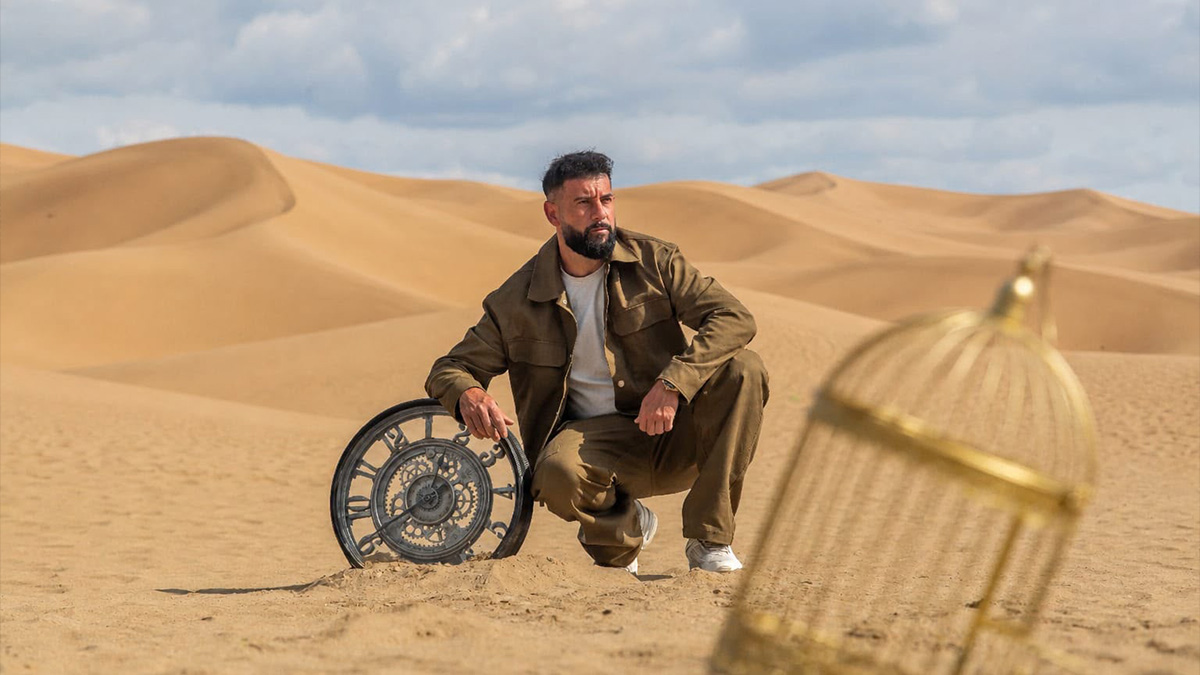
From Ortom’s rap beginnings to piano-led songwriting, Thomas Perrier has built his career around one constant: writing. With Temporalité, his third album in this form, the singer-songwriter turns the passing of time into musical material, making transmission the central thread running through twelve songs deliberately conceived outside today’s dominant formats.
Before Thomas Perrier, there was Ortom. And before the piano, there was rap.
Thomas Perrier began writing at around 15 or 16, immersed throughout his teenage years in what he describes as the first golden age of French rap. Writing came before everything else. He started recording demos of his own tracks, and this first chapter eventually led to Pas un jour dans une ligne, a rap album released nationally in 2006 under his original stage name, Ortom.
That detail helps explain much of the artist Thomas Perrier would later become. Behind music now largely driven by piano, and an identity firmly rooted in songwriting and poetry, remains an approach to language inherited from rap: an attention to rhyme, sound, double meanings and structure.

“Rémy”, the Song That Changed Everything
The real turning point came a few years later.
In 2009, Thomas Perrier was asked to write “Rémy”, a piano-and-voice track telling the true story of a young man who became quadriplegic following an accident.
The stripped-back piano-and-voice format changed his relationship with music. More importantly, the response to the song gave him the feeling that he had finally found something that truly belonged to him: poetic, sensitive and finely crafted writing, where the technical precision inherited from rap could coexist with melody and deeply human storytelling.
The change in form did not mean abandoning his past. Perrier retained the same demands when it came to writing, but shifted the centre of gravity. A song was no longer built solely around lyrical technique: it had to tell a story, communicate something and provoke an emotion.
Then came silence.
Around 2010, he stopped writing regularly. Partly because he lacked the time, but also because the desire had faded. The break would last several years.
Writing to Silence the Anxiety
Thomas Perrier returned seriously to writing in 2017, this time under far more personal circumstances.
Living with chronic anxiety, he began writing extensively at night to, in his own words, “make my nighttime anxieties disappear.”
Writing was no longer simply an artistic act. It had become almost a necessity.

This particularly productive period resulted in around forty demos. Some of them would later find their way onto his first two piano-and-voice albums, composed with pianist Hugues Delevoye.
Écrire délivre, followed by Au pied de la lettre, gradually established this new artistic identity. Temporalité now extends that journey.
The piano remains at the heart of his search for balance between the power of words and emotion. But with this third album, Thomas Perrier has also decided to open a few windows.
Temporalité: Moving Beyond Piano and Voice
For Temporalité, Perrier brought in other producers and opened his music to new sounds. Piano and voice remain dominant, but they no longer necessarily define its boundaries.
This evolution matters because it mirrors the development of the writing itself. Thomas Perrier is not trying to transform his project simply to fit a new era. If anything, the opposite is true.
“I’m not looking for a radio format or a TikTok format. I just want to touch people’s hearts by telling stories that speak across generations.”
His ambition lies elsewhere: to convey emotion, bring poetry into his songs and try to create music capable of standing the test of time.
That position is directly reflected in the way the record has been conceived. Temporalité is intended as a work to be experienced from beginning to end rather than simply a collection of songs. Each track represents a moment, an emotion, a period in life or a question.
In a music industry increasingly built around individual tracks, Thomas Perrier continues to think in terms of albums.
And that choice feels particularly coherent for a record devoted precisely to time.
Twelve Songs, Different Ages of a Life
Temporalité features twelve tracks:
Temporalité · Ode à la pluie · Valentine · Mèche à feu · Il est elle · Sahara · Amour déguisé · Médusa · La langue · Ode à la jeunesse · Les fenêtres · À la recherche du bonheur.
Across them, love, youth, happiness, memories, encounters, desire and waiting all emerge. But the record is not simply a sequence of universal themes.
Everything is connected by time.
The time we wish we could stop. The time we spend waiting. The time we regret. The time that transforms love, youth and memory. And ultimately, the time we still have left.
As Thomas Perrier himself puts it: time is not simply the album’s theme. It becomes the connection between generations, memories, love, youth, ageing and transmission.
That is probably where the record’s real ambition lies.
Temporalité could easily have become an album about nostalgia. Instead, it chooses to focus on the present. Despite its subject matter, the project is not conceived as a nostalgic record, but as a journey through the present.
From French Rap’s First Golden Age to Chanson
There is ultimately a clear thread connecting the teenager who discovered writing through French rap, Ortom in 2006, the artistic turning point of “Rémy” in 2009, his return to writing amid anxiety in 2017, and the Thomas Perrier behind Temporalité.
That thread is writing.
The forms around it have changed.
Rap gave way to piano and voice. Piano and voice are now opening up to other forms of production. But the determination to work meticulously with words remains. Today, Thomas Perrier embraces a form of French chanson that seeks neither to reproduce the dominant codes of rap nor those of contemporary pop, instead prioritising precision, imagery, rhyme, double meanings and emotion.
His work also shows a desire to create dialogue with seemingly distant musical territories. His relationship with classical music and his tribute to Frédéric Chopin, for instance, create another bridge between poetry, songwriting and music.
Time as a Subject — and as a Journey
This may be what makes Temporalité particularly coherent with the story of the artist who created it.
Thomas Perrier could have made an album about time without the idea extending beyond the songs themselves. But his own journey gives the subject another dimension.
There is the 15-year-old discovering writing.
The rapper Ortom.
The writer of “Rémy”.
The years without writing.
The anxious nights when the words returned.
The forty demos.
Then the albums, the piano, and now this desire to broaden the production without abandoning what lies at the heart of the project.
Temporalité therefore approaches time in several ways. There is the time experienced by its characters and within its stories, of course. But there is also the time an artist needs to understand what he truly wants to do with his writing.
Thomas Perrier no longer seems particularly interested in the race to create the most immediately consumable song. His ambition is almost the opposite: to write songs that will still have something to say long after the context in which they were released has disappeared.
“In reality, everything is a question of timing.”
And after twenty years of writing, interruptions and new beginnings, the title seems to describe Thomas Perrier almost as much as it describes his new album.