
Banning the Hijab in the Name of Secularism: The Contradiction at the Heart of the National Rally’s Proposal !
The National Rally is now openly considering fining women who wear the hijab in public spaces. The measure is being presented as a way to combat Islamism and defend the values of the French…
 Written byZEZ XXI — Mazdak Vafaei Shalmani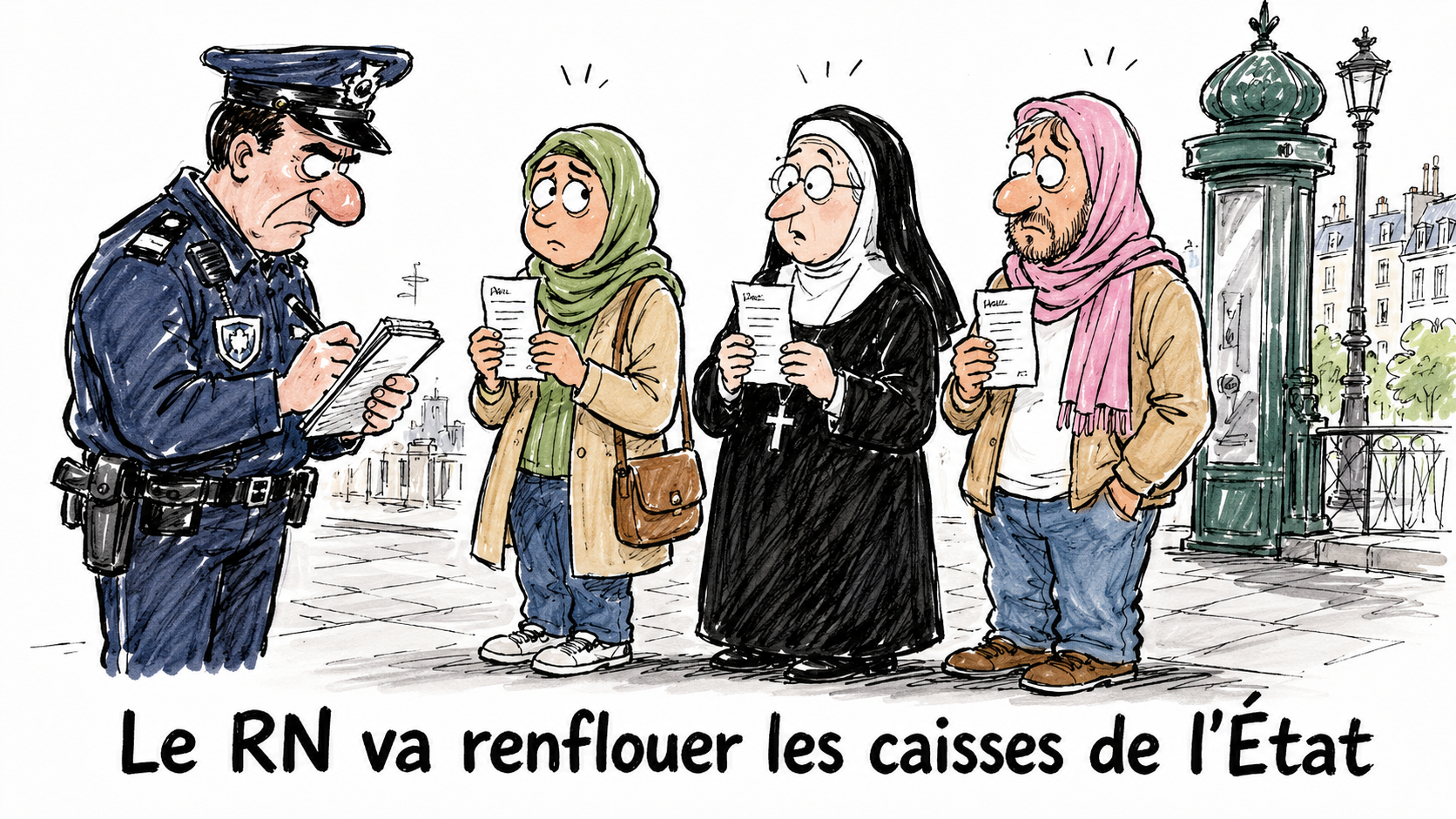
The National Rally is now openly considering fining women who wear the hijab in public spaces. The measure is being presented as a way to combat Islamism and defend the values of the French Republic. Yet from a legal standpoint, it raises a considerable paradox: secularism primarily requires the State to remain neutral, not its citizens. It also protects freedom of conscience and the free exercise of religion.
The French debate over the Islamic veil has therefore entered a new phase. The issue would no longer be limited to public schools, government employees or specific circumstances, but could potentially extend to the street itself. A woman could therefore face a fine simply for wearing a headscarf that leaves her face entirely visible.
This proposal raises a fundamental question: can secularism be invoked to prevent citizens from expressing their religion in public when secularism itself is meant to guarantee freedom of conscience?
The hijab is not the burqa: France would be going much further than its European neighbours
The hijab, niqab and burqa are regularly conflated in public debate. Yet from a legal perspective, the distinction is crucial.
The hijab covers the hair and sometimes the neck, while leaving the entire face visible. The niqab covers the face except for the eyes, while the burqa conceals it completely.
Several European countries have indeed introduced restrictions on clothing that conceals the face. These include France, Belgium, Denmark, Austria and Switzerland. But these laws are generally framed around the concept of concealing the face, rather than banning the religious practices of a particular faith.
France’s 2010 law, often described as a “burqa ban”, does not actually mention Islam or the Islamic veil. It prohibits wearing clothing designed to conceal the face in public spaces.
That distinction is crucial.
Requiring someone to show their face so that they can be identified in certain circumstances is not legally equivalent to telling them: “your face is perfectly visible, but your religious symbol is prohibited.”
Across the European Union, a nationwide blanket ban on the conventional hijab throughout public spaces is not currently the norm. Restrictions do exist in certain schools, government institutions, public-sector positions and professions, but they are generally justified by requirements relating to institutional neutrality, security or specific circumstances.
A French law directly targeting the hijab in the street would therefore represent a significant departure from the prevailing European approach.
Secularism requires the State to remain neutral, not its citizens
This is perhaps where the proposal’s central paradox lies.
In French political debate, secularism — or laïcité — is sometimes portrayed as requiring everyone to keep their religion within the private sphere.
But that is not exactly what French law says.
Religious neutrality applies first and foremost to the State, public authorities and public servants when carrying out their official duties. A civil servant, for example, may not openly express their religious beliefs while performing public-service duties.
Ordinary citizens, however, are not subject to the same obligation of neutrality.
The principle of secularism also entails respect for all beliefs, equality between citizens regardless of religion and freedom of conscience.
In other words, the French Republic must remain neutral. Its citizens, however, are free to be Muslim, Christian, Jewish, atheist, Sikh or to hold any other belief.
This is precisely what would make a law fining a woman for wearing a hijab in the street legally problematic.
A question of equality before the law
A specific ban on the Islamic veil would also raise an obvious question of equality.
Why should a woman wearing a hijab face a fine while a man wearing a kippah, a Sikh turban or a visible Christian cross remains free to walk through the same public space?
Lawmakers can, of course, establish different rules for different situations, or when sufficiently compelling public-interest considerations justify different treatment.
But it would still be necessary to demonstrate why the hijab, which does not conceal the face, would in itself create a sufficiently serious disturbance to justify a blanket restriction on religious freedom.
The issue becomes even more sensitive when a measure explicitly targets a practice associated with a single religion.
The legal question could therefore be summarised as follows: how can a law be defended in the name of secularism if that very law leads the State to distinguish between citizens according to the religious symbol they wear?
Religious freedom can be restricted — but not without justification
Religious freedom is, of course, not absolute.
Public order, security, the proper functioning of public services and the rights of others can justify certain restrictions.
This is what makes it possible, for example, to require religious neutrality from public servants or to regulate certain forms of dress in specific circumstances.
But any blanket restriction must be capable of being considered both necessary and proportionate.
In the case of a woman simply wearing a hijab in the street, with her face fully visible and identifiable, such a justification becomes considerably more difficult to establish.
France’s Council of State had already pointed out, during the debate surrounding the full-face veil, that the principle of secularism could not, on its own, provide sufficient grounds for a blanket ban on religious clothing throughout public spaces.
That is precisely because secularism does not mean erasing all religion from society.
By turning the veil into a problem, has France turned it into a symbol?
At this point, the issue goes beyond the law and becomes political and social.
For more than thirty years, the Islamic veil has repeatedly returned to the centre of French political debate: headscarves in schools, mothers accompanying school trips, the burkini, universities, sport, the abaya and now potentially public spaces themselves.
By repeatedly presenting this garment as a national problem, has France itself contributed to giving it an increasingly powerful political significance?
For some women, wearing the hijab is primarily a matter of religion. For others, it can also become a cultural or identity marker. And for some young French women, it may even acquire a protest dimension in response to the feeling that they are constantly being singled out as a problem.
This obviously does not mean that every woman wearing a hijab is engaging in an act of resistance.
But the more aggressively a symbol is targeted politically, the greater the risk that it becomes precisely what those targeting it sought to prevent: a symbol of resistance.

Can women be liberated by deciding what they are allowed to wear?
Finally, there is a genuine feminist debate surrounding the hijab.
Some feminist movements regard the hijab as a symbol of patriarchy and argue that it embodies social and religious pressure imposed on women.
This criticism cannot simply be dismissed. In several countries, women are indeed forced to cover themselves and can face extremely severe punishment if they refuse to do so.
But this immediately raises another question: can one form of compulsory dress imposed on women be fought by imposing the opposite dress code on them?
Telling a woman that a man, her family or a religious authority has no right to force her to wear a veil is a defence of her freedom.
Telling her that the State will fine her if she nevertheless chooses to wear one follows a very different logic.
In both cases, her body becomes the battleground on which others decide what she should or should not wear.

Integration rather than exclusion
If some women genuinely face pressure from their families, communities or religious circles, would excluding them further from public life really make them more autonomous?
A fine would inevitably affect first and foremost those who continue to wear the hijab despite the ban. Such a measure could therefore target a population already exposed to discrimination and deepen its sense of exclusion.
Education, financial independence, access to employment, dialogue and social integration may be less politically spectacular than a ban.
But when it comes to combating religious fundamentalism, society must also ask whether integration might ultimately prove more effective than exclusion.
Extremism thrives precisely when entire groups feel cut off from the society in which they live.
The issue therefore goes far beyond a piece of fabric.
Is the best way to fight extremism through integration — or through national disintegration?
The National Rally argues that a ban would help combat Islamism and protect women. Its opponents argue, on the contrary, that it would effectively turn religious freedom into an offence and improperly extend to ordinary citizens an obligation of neutrality that primarily applies to the State.
Behind this confrontation lies a much simpler question:
The French Republic is secular. But does that mean its citizens must also be religiously neutral?
Under French law as it currently stands, the answer is no.