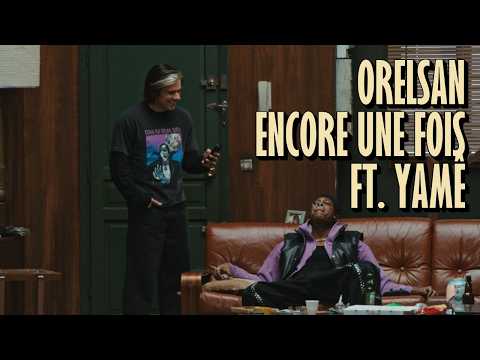
OrelSan and Yamê do it “Encore une fois”.
OrelSan has just lifted the veil on "La fuite en avant" (“The Headlong Rush”), a project that further cements his status as a generational icon. For over a decade, the Caen-born rapper has established…
 Written byZEZ XXI — Mazdak Vafaei Shalmani
Dans cet article
OrelSan has just lifted the veil on “La fuite en avant” (“The Headlong Rush”), a project that further cements his status as a generational icon. For over a decade, the Caen-born rapper has established himself with a voice that is both cynical and clear-eyed, favoring the “loser trip” over inflated displays of ego and the hyper-masculine posturing that long dominated French rap. With him, audiences didn’t just listen to albums — they grew up alongside him, navigating doubt, excess, and self-questioning.
From the outset, OrelSan portrayed the drift of a young man lacking direction on “Perdu d’avance”. That was followed by a confrontation with fame, before a more direct reckoning with adulthood on “La fête est finie”. A sharp observer of his time, he has consistently bridged the personal and the collective. On “L’odeur de l’essence”, his tone turns heavier, almost disillusioned, as he confronts the fractures of a society changing too fast — and often without purpose.
With “Civilisation”, his previous album, OrelSan reached a historic milestone: over one million copies sold and a double diamond certification in France. Alongside his musical trajectory, he has expanded into film and documentary. His brother directed a documentary tracing his artistic genesis, while “Yoroï”, released in 2025, explores his anxieties around fatherhood through an aesthetic steeped in Japanese culture and fantasy cinema.
Whether he likes it or not (“Quand est-ce que ça s’arrête ?” — “When does it stop?”), OrelSan now stands at the top. He is no longer just a standout rapper; he has become a central figure in the French music landscape.
“La fuite en avant” also posted an impressive debut, approaching 60,000 sales in its first week alone. OrelSan supports the release with the visual for “Encore une fois”, featuring Yamê.
Yamê, who broke through to a wider audience after his standout performance on A COLORS SHOW with “Bécane”, embodies a similarly strong sense of individuality. In a rap landscape increasingly shaped by dominant waves — drill, Jersey club, and pop or Afro-infused hybrids — he asserts a vocal and artistic identity that is instantly recognizable. In his own way, he shares with OrelSan a refusal to conform.
Never one to stack opportunistic features, the Caen rapper selects his collaborations carefully. His alliance with Yamê feels less like strategy and more like artistic inevitability.
OrelSan and Yamê do it “Encore une fois”.
The instrumental is crafted by Phazz and Skread. While Skread remains OrelSan’s longtime musical partner, present since the early days, Phazz has also played a major role in shaping his sound, notably on “Défaite de famille”, “Christophe”, “La Quête”, and “Athéna”, taken from “Civilisation”.
The production, almost “grotesque” in its exaggerated edge, thrives on contrast and irony. It perfectly mirrors the “loser trip” embraced by OrelSan, who narrates his post-party “social jetlag”:
“I wake up at noon, head spinning, mouth on fire
Feels like I spent the night inside an ashtray
The first thing I tell myself is ‘never again’
The second is ‘can’t wait for six p.m. so we can start knocking them back again’”
A theme already sketched out on “La fête est finie”, where he dissected his nocturnal excesses and their consequences. The collective Asocial Club tackled similar self-destructive patterns on “Anticlubbing”. With OrelSan, the party is never entirely carefree — it’s a cycle he struggles to break.
The video, directed by Martin Raffier, embraces a distinctive visual concept. OrelSan and Yamê move through a set designed like an opened dollhouse, drifting from one apartment to another as the narrative unfolds. Coming from the world of short films and advertising, the director previously helmed “The Greatest Man on Earth” and “The Launch”. He also directed the video for “M.VI” by Chaax, confirming his taste for stylized, narrative-driven visuals.