
For Abd Al Malik: “No Justice, No Peace!”
Some still caricature Abd Al Malik’s trajectory, reducing it to conscious, poetic slam too quickly dismissed with a throwaway “It’s heavy”. A lazy reading that overlooks his early years in a far harsher atmosphere…
 Written byZEZ XXI — Mazdak Vafaei Shalmani
Dans cet article
Some still caricature Abd Al Malik’s trajectory, reducing it to conscious, poetic slam too quickly dismissed with a throwaway “It’s heavy”. A lazy reading that overlooks his early years in a far harsher atmosphere with the Strasbourg-based group N.A.P. Tracks such as “Le Chant des signes” or “La Fin du monde” were already sketching the outlines of a genuine social and moral apocalypse. In eastern France—then largely absent from the rap spotlight—the scene was nonetheless deeply politicised. N.A.P, like Abd Al Malik later on as a solo artist, has always championed conscious, committed rap, without ever slipping into didactic sermonising.
In 2014, Abd Al Malik adapted his own novel for the screen with “Qu’Allah bénisse la France”. A film with openly embraced rough edges, carrying both its strengths and its fragilities. The rapper-turned-director puts forward a vision of Islam stripped of clichés, while advocating for a pacified reading of relations between communities. A tone that some cinephiles—as well as parts of the urban scene—found too “calm”, too “pacified”. Yet today, this measured discourse stands out for its rare coherence, at a time when slogans of hatred are loudly flourishing on all sides of the global political spectrum.
The artist now returns with a new feature film: Furcy, l’Héritage. In this self-directed work, Abd Al Malik retraces the struggle of Furcy, an enslaved man who dared to demand his freedom before a court of law. The project is supported by several major figures of French cinema, including Romain Duris—long regarded as Cédric Klapisch’s muse—and Philippe Torreton. The lead role is entrusted to Makita Samba, who embodies Furcy with a restrained yet deeply inhabited presence.

In a France that yields a little more each day to extremisms of all kinds, and in a Europe dangerously flirting with nationalist and racist ideologies already responsible for its downfall nearly seventy years ago, Abd Al Malik’s film resonates as both an act of courage and a necessary reminder. The history of slavery does not belong to a distant past—it still runs through our societies. Peace between peoples also requires a sincere, clear-eyed, and fully assumed duty of remembrance.
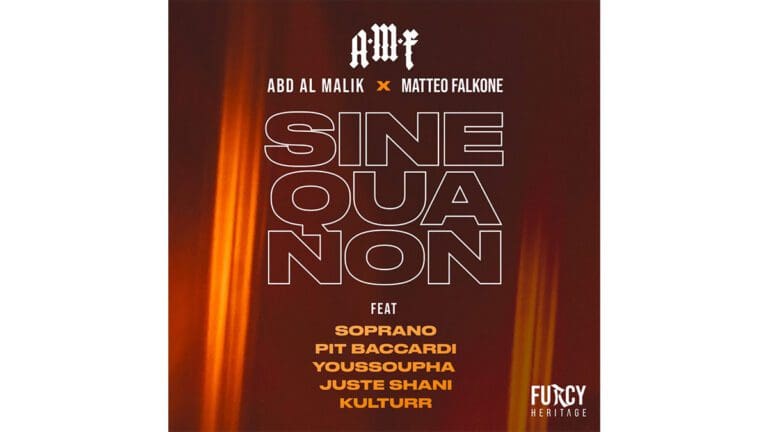
Extending the film’s message, Abd Al Malik recently unveiled the track “Sine Qua Non”, taken from the soundtrack of Furcy, l’Héritage. This engaged posse cut brings together a host of rappers renowned for the precision and depth of their writing. A dense, uncompromising track, destined to leave a lasting mark. “Sine Qua Non” features Matteo Falkone, Kulturr, Pit Baccardi, Juste Shani, Soprano and Youssoupha.
Abd Al Malik pounds home a reconciliatory republican motto:
“No justice, no peace!”
The instrumental is signed by Bilal Al Aswad, a historic member of N.A.P and long-time collaborator of Abd Al Malik. A founding figure of French conscious rap, he delivers a modern, deliberately minimalist production here—a tense soundscape that gives full space to the power of the words. Pit Baccardi, Youssoupha, Soprano and Abd Al Malik, all seasoned lyricists, carry an anthem dedicated to the man who demanded his freedom before the courts—an irony all the more striking when one reflects on the very meaning of the word “justice”. Both the film and the musical project invite a profound reflection on this concept, and on its relativity within the framework of the State.
Several lyrics stand out for their blunt directness. The artists take turns delivering verses that are sometimes strikingly raw, far removed from the polished image still associated by some with Abd Al Malik. Each voice comes forward with its own history, its own legacy, its own degree of rebellion.
“No peace unless Babylon pays” — Pit Baccardi
This reggae–ragga slogan, echoed countless times throughout the history of protest music, opens the track without compromise. The verses then follow, sharp and cutting:
“I obey neither your grandmother nor your great-aunt,
They like to say they helped Africa,
They forget to say she never consented.”
Youssoupha aptly reminds us that the notions of “immigrant” or “expatriate” are never neutral, but depend entirely on perspective and place:
“Where they’re from I’m an immigrant, where I’m from they’re expats.”
And the closing line lands like a statement of faith:
“I am and will remain a free man, like the wind.”
Abd Al Malik’s choice of subject is anything but incidental. Without resorting to amalgam or anachronism, he draws an illuminating parallel with the tensions running through contemporary France. Long deemed too polished, the artist delivers here a resolutely corrosive track—at the risk, this time, of being reproached for the exact opposite.