
Booba Releases AI-Generated “Les Zhommes” Video from “Blanco Nemesis”
Eleven years after « Nero Nemesis », Booba unveils its brighter counterpart with « Blanco Nemesis », released in May 2026. By the end of its first week, the project had generated just under…
 Written byZEZ XXI — Mazdak Vafaei Shalmani
Dans cet article

Eleven years after « Nero Nemesis », Booba unveils its brighter counterpart with « Blanco Nemesis », released in May 2026. By the end of its first week, the project had generated just under 10,000 album-equivalent units. Several months before its release, the rapper had already outlined the album’s concept in an interview with Le Parisien:
« It’s coming. People will have to wait a little longer. Blanco Nemesis will be released during the first half of 2026, eleven years after Nero Nemesis, which is regarded as my best album. This is its lighter counterpart. It all comes back to our one true battle: light versus darkness. »
This contrast between light and darkness offers a fitting summary of an artist who has spent more than two decades attempting to stay ahead of French rap’s major transformations. With « 0.9 », Booba played a major role in bringing Auto-Tune into the French mainstream, despite facing a wave of criticism at the time. The vocal effect was already firmly established in the United States, largely thanks to artists such as T-Pain. A few years later, a significant part of the French rap scene would ultimately embrace the same aesthetic. Booba later pointed out the irony on « Trône »:
« Ever since “0.9”, they criticised it, but they all ended up overusing Auto-Tune. »
More broadly, the rapper has repeatedly helped push the genre beyond its established musical boundaries. He supported the rise of melodic French urban music with tracks such as « Petite Fille », explored reggaeton influences on « Validée »—following an earlier venture into that sound alongside Farruko—and played a decisive role in the emergence of trap music in France by backing Kaaris at the beginning of his career. While he did not necessarily invent each of these movements, he consistently showed an ability to recognize new trends, absorb them into his own universe, and give them crucial mainstream exposure.
With « Blanco Nemesis », Booba continues along the same path, this time openly embracing artificial intelligence as part of his creative process. During an appearance on « Carré d’As », broadcast by OKLM, he described AI not as a replacement for the artist, but as another creative tool—comparable to the role Pro Tools played in the rise of digital music production:
« When I open my emails, I don’t give a fuck whether it came from a human or an AI. It’s the same to me. »
For Booba, technology does not eliminate the need for taste, selection, or artistic direction. It simply provides raw material that the artist must still choose, reshape, and bring to life. After Auto-Tune, melodic urban music, and various Latin-inspired crossovers, artificial intelligence could therefore represent another major shift that the DUC has managed to embrace ahead of many of his competitors.
This idea takes concrete form with « Les Zhommes », a track taken from « Blanco Nemesis ». To accompany the song, the rapper released a black-and-white music video created entirely with artificial intelligence, visually extending the album’s aesthetic.
Booba Expands the World of « Blanco Nemesis » with « Les Zhommes »
The instrumental production is credited to Zee Beatmaker and Baile Brolike. One of the most prominent producers on « Blanco Nemesis », Zee Beatmaker contributed to several of the album’s key tracks, including « Kendall », « Tempête », « Inconditionnel », and « Tout ira bien ». His work helps give the project its sonic consistency, blending spacious production, melancholic melodies, and sharper rhythmic patterns.
Baile Brolike, meanwhile, has a long-standing connection to the musical landscape surrounding Booba. The producer previously worked with PNL on « Mira » and produced « ZER », one of the standout tracks from « Nero Nemesis ». On « Les Zhommes », the two beatmakers create a production that feels both expansive and stripped back, remaining faithful to the brighter tone of « Blanco Nemesis » without erasing the coldness that continues to define Booba’s writing.
Beneath that apparent brightness, however, Booba remains true to one of his defining strengths: weaving references, personal scores, and provocations directly into his verses. He notably takes aim at XVBarbar and Leto:
« Sauf qu’il faut arrêter tôt (les Zhommes), comme XVBarbar et Leto (les Zhommes)
Taureau le long de mon cognac, rien sur le caillou comme Kojak »
The rapper also delivers another jab at Laurent Bouneau, with whom he has maintained a long-running feud:
« Le 11.43 te met au pas (les Zhommes), c’est pas l’effet placebo (Les Zhommes)
J’ai produit Yakalelo (les Zhommes), fuck un colon, fuck Laurent Bouneau (Les Zhommes) »
By referencing « 11 h 43 contre les lois racistes », Booba also invokes a foundational chapter in the history of French rap. Released in the context of the Debré and Pasqua immigration laws, the collective track became one of French hip-hop’s most powerful symbols of resistance against discriminatory migration policies. The reference allows the rapper to connect his own career to a broader political memory, while also recalling that French rap was built, in part, as a space for protest and social opposition.
The music video was directed by GLYTCH, a creator specializing in AI-generated visual productions. He has gained recognition through a series of visual worlds inspired by artists such as Kanye West, Billie Eilish, and The Weeknd. Frequently shared across social media, his work regularly surpasses one million views.
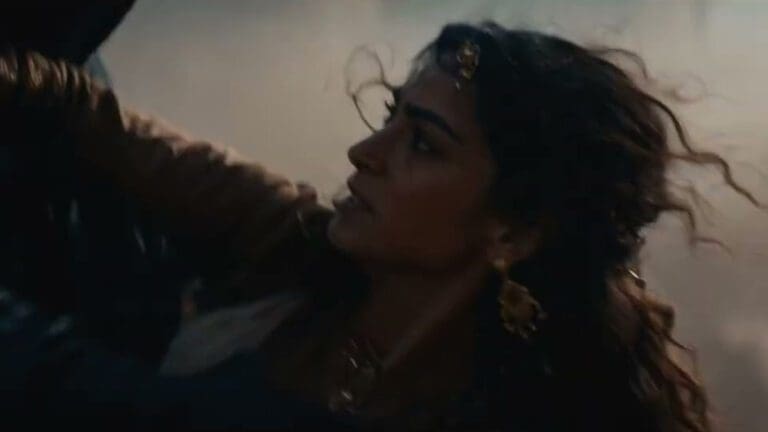
For Booba, GLYTCH imagines a fully black-and-white apocalyptic world. The silhouettes, devastated landscapes, and almost unreal atmosphere give the song a twilight-like quality that contrasts with the promise of light carried by « Blanco Nemesis ». It is a paradox that perfectly fits the world of the DUC, where light is never revealed without leaving a trace of darkness behind.
