

With Pilote, Aliking delivers more than just another project. He sets a clear direction, asserts a vision, and builds a cohesive universe where every element — from the visuals to the tracks — contributes to a unified artistic momentum. More than an album, Pilote stands as a statement of intent.
A minimalist yet deeply symbolic cover
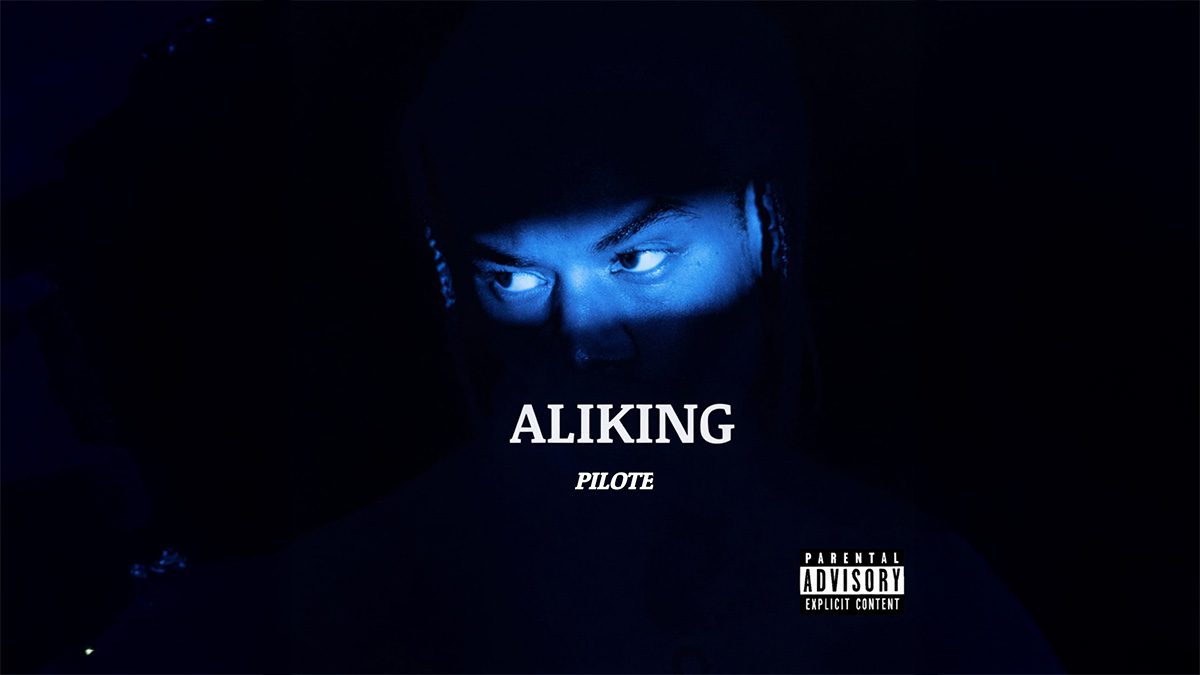
At first glance, the artwork for Pilote establishes a distinct atmosphere. Dominated by a deep blue tone, it reveals the face of Aliking, partially hidden beneath a hood and illuminated by a cold light. Only his eyes break through the darkness, conveying both vigilance, distance, and determination.
At the center, the name ALIKING appears in clean white lettering, alongside the title Pilote, in a deliberately stripped-down aesthetic. The Parental Advisory sticker reinforces the project’s roots in rap culture.
Beyond its visual appeal, this artistic choice carries deeper meaning. The dominant blue tone inevitably recalls Mauvais Œil by Lunatic, a cornerstone of independent French rap. Released in 2000, the album made history by going gold without the backing of major labels.
By embracing this cold, minimalistic palette, Aliking positions Pilote within that same lineage of independence and artistic autonomy — a stance that feels both intentional and fully embraced.
An introspective journey from the very start
The project opens with Zeta, an introduction that immediately immerses the listener in a cosmic imagery already hinted at in Fève. Referencing the Zeta Reticuli constellation, the track sets a floating, almost meditative tone.
“More success, eyes on me, happiness is coming — it just takes time.”
From the very first lines, Aliking lays out his core themes: ambition, pressure, and introspection. It works as a gateway into a deeper, more contemplative space.
Sully: cinematic tension and striking contrast
With Sully, the project shifts into darker territory. The writing becomes sharper, more visual — almost cinematic.
“He’s angry, he knocked — knock, knock, knock — and then he killed Jamie… Sully.”
The reference to Top Boy is clear, but the track goes further. The “knock knock knock”, reminiscent of a children’s rhyme, creates a disturbing contrast between innocence and violence, amplifying the track’s impact.
Éternel: a step toward accessibility
With Éternel, Aliking explores a more melodic direction. The track leans into a pop-urban aesthetic, making it more accessible.
“‘I love you’ is like men — it doesn’t last forever.”
A simple yet powerful line that captures the fragility of human emotions. Supported by a catchy production, the track clearly holds crossover potential.
Private: a statement of independence
On Private, Aliking fully embraces his independence. Named after his label Private Music France, the track serves as a manifesto.
Driven by a drill production marked by a ticking clock, the track builds a constant sense of tension.
“I’m in the streets, the ground is mined…”
But more importantly, he delivers a direct critique of the industry:
“No twerking on my tracks — on theirs, it’s all production, no substance left.”
A pivotal moment in the album, signaling a shift in tone.
A lucid and disillusioned perspective
With Comme dit la légende, Aliking deepens his introspection and presents a darker worldview.
“I’ve seen too much from their hands, I met love — she had too much to drink.”
The tone is cold, almost fatalistic. Yet he broadens his scope:
“The tears of Kinshy — my poetry.”
By referencing Kinshasa, he transforms collective reality into artistic material, giving his writing a broader dimension.
Lionceau: legacy and determination
On Lionceau, the influence of 90s boom bap is unmistakable. Aliking asserts both his determination and his vision.
“I build without empathy — I am an empire.”
The track also takes aim at industry practices:
“I hand out little cookies to all those stream buyers.”
Rois du monde: a brighter shift
With Rois du monde, the artist expands his sonic palette. Reggaeton influences bring a warmer, more melodic feel.
“I move forward alone, with real ones through my pain…”
The track feels almost like a sung poem, with clear mainstream appeal.
Irrécupérable: back to raw energy
On Irrécupérable, Aliking returns to a more rugged, stripped-back sound.
“They told me I’m not nice — I prefer N.I.”
“My hate is multicolored — I settle things without Colors.”
The tone remains confrontational, extending his critique of the current rap landscape.
An intimate and emotional ending
The project closes on a more vulnerable note. Aliking tells the story of a distressed young woman:
“It’s the story of a girl crying in her bed… miskine, don’t cry…”
A simple yet touching conclusion that adds emotional depth to the project.
Conclusion: a defining project
With Pilote, Aliking delivers a cohesive body of work driven by a constant tension between introspection and self-assertion. Blending independent rap influences, sonic experimentation, and sharp industry critique, he establishes a strong artistic identity.
A project that lives up to its name: Aliking is in control — and he’s charting his own course.


