
When did politics turn into a rap game?
For a long time, politics was structured around ideologies, collective projects, and worldviews. Political divisions were rooted in ideas, doctrines, and competing visions of society. Today, the nature of public debate appears to have…
 Written byZEZ XXI — Mazdak Vafaei Shalmani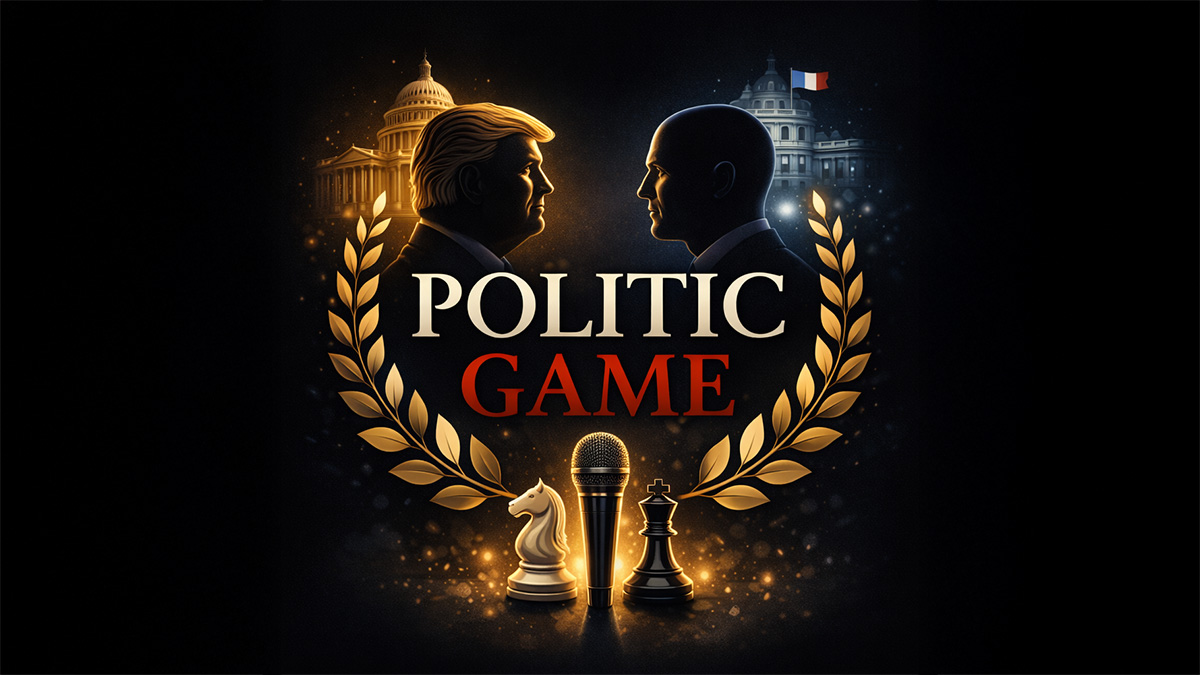
For a long time, politics was structured around ideologies, collective projects, and worldviews. Political divisions were rooted in ideas, doctrines, and competing visions of society. Today, the nature of public debate appears to have fundamentally changed. Punchlines, clashes, sound bites, and personal staging now dominate the media landscape. Contemporary politics has adopted codes long associated with the rap game: personalized confrontation, storytelling, and symbolic domination.
This shift is neither anecdotal nor uniform. It first emerged in France, reached its peak in the United States, and has since begun to spread across the European political landscape.
France: from collective narratives to individual storytelling
In France, the rupture has been clearly identified and theorized. The publication of the book Storytelling marked a key moment in the analysis of contemporary political power. In it, Christian Salmon describes the gradual decline of classical ideological discourse in favor of narratives centered on the individual—constructed, scripted, and mediated.
The presidency of Nicolas Sarkozy embodies this turning point. Sarkozy explicitly claimed his rejection of ideology, stating: “I am not an ideologue.” This declaration is far from trivial. It signals a profound transformation: power is no longer justified by a higher idea or a collective project, but by a personal trajectory, a style, and an ability to occupy media space.
Before this period, despite their contradictions, major French political families remained structured around collective narratives. On the left, socialism, communism, or social justice still formed a clearly identifiable ideological horizon. On the right, the state, the nation, and the common good remained central references, including under the presidency of Jacques Chirac.
With Sarkozy, the staging of private life became an openly assumed element of political narrative. The press conference in which he declared, “With Carla, it’s serious,” perfectly illustrates this shift. The boundary between private and political spheres blurred. The president was no longer judged solely on his actions or ideas, but on his personal story, his image, his narrative. Politics began to function as a continuous storyline, closely aligned with the logic of entertainment.
United States: Trump and politics as permanent reality TV
If France initiated this movement, the United States offer its most fully developed form. With Donald Trump, politics fully embraced the codes of reality television and permanent confrontation.
Trump is not merely a media-savvy leader; he is a former reality TV host and producer. He applies the rules of spectacle to politics: simplified narratives, a central hero, clearly identified enemies, repeated punchlines, and symbolic domination. On Twitter/X, his messages are short, aggressive, and designed to be shared and remembered. They are not meant to explain complex public policy, but to strike public opinion.
The confrontation with Nicolás Maduro illustrates this logic. Before any diplomatic or strategic action, Trump staged a public confrontation through tweets: Maduro was labeled a dictator, an usurper, an enemy of the Venezuelan people. These statements, widely circulated on Twitter, functioned as geopolitical punchlines.
The sequence is revealing: communication precedes action, staging prepares sanction. Economic sanctions, diplomatic pressure, attempted arrests, or indirect operations all fit into a narrative already written. Even when taking real geopolitical context into account, this logic can be analyzed as a form of symbolic punitive expedition, where personalized confrontation replaces traditional diplomatic debate.
In this context, it becomes relevant to speak of a clash between heads of state—not in the traditional sense of international relations, but as a mediated, scripted confrontation aimed as much at public opinion as at institutions.
A dynamic that goes beyond France and the United States
This model is no longer strictly Franco-American. Across Europe, these codes are gradually circulating. The personalization of power, the search for punchlines, the staging of conflict, and the centrality of social media are also transforming national political debates.
European political leaders, even within historically more consensual systems, are increasingly adopting communication strategies based on emotion, confrontation, and audience loyalty. The battle of ideas is giving way to individual narratives and symbolic conflict.
Conclusion
Contemporary politics did not transform by accident. It has absorbed the codes of the rap game and entertainment because those codes are effective in a saturated media environment. Punchlines, storytelling, clashes, personalization: power is now also played out on the terrain of performance.
The question is no longer simply whether this evolution is desirable, but what it does to democratic debate. When politics becomes a confrontation between personalities rather than a conflict of ideas, the very nature of public debate is transformed.