

This is a quiet revolution of which Yasmine is not only the most visible figure, but arguably its most striking culmination. Just a few weeks after the release of her debut official single, the Belgian singer has already racked up over 100,000 streams, while landing on playlists on Générations FM and Tarmac. A rapid breakthrough that raises one key question: where does this sudden emergence really come from?
Even before unveiling this first single, Yasmine had carefully built a connection with her audience, establishing a steady rhythm by releasing one track per month. A long-term strategy, reinforced by notable live exposure as she opened for Danyl. While some artists owe their rise to well-executed marketing, Yasmine stands apart: here, the artistic substance comes first—and ultimately transcends the strategy itself.
To fully understand this dynamic, we need to look back a few decades. In the 1980s and early 1990s, French chanson and the French-Canadian scene shared a strong aesthetic proximity, fostering almost fraternal exchanges. With the rise of urban music, these connections gradually shifted toward new territories, particularly North Africa and Sub-Saharan Africa. Today, French-speaking artists enjoy massive success across the African continent, while figures such as TIF, ElGrandeToto, and Himra have firmly established themselves within the French music landscape.
This cultural dialogue is nothing new. From the early days of rap, artists have incorporated these influences—like Freeman with “Bladi”, or more recently Rim’K, TIF, and Sofiane Pamart. In a different yet complementary way, MHD, Aya Nakamura, and Dadju have also contributed to bridging these cultures, helping reshape the contours of contemporary French-speaking popular music.
Within this broader context, Yasmine fits seamlessly into this lineage. Her track “Ma mère c’est mon père”, infused with oriental sonorities—particularly through its instrumental choices—stands as the refined expression of a movement that has been unfolding for years. Artists like Nej or Lartiste, who embody this bridge between the Maghreb and France, further illustrate this evolution.
With “Ma mère c’est mon père”, Yasmine does more than follow a trend—she crystallizes it.
For Yasmine, “Ma mère c’est mon père” says it all.
The track’s production is handled by Nico Saint P, who previously collaborated with Yasmine on “Le Passé”. Here, he brings together derbouka percussion and the distinctive tones of the ney to craft an atmosphere that is both immersive and hard-hitting. While the title may initially suggest a tribute to her mother, the track ultimately stands as a bold statement of identity. With a subtle touch of ego-driven energy, Yasmine asserts her fighting spirit and lays the foundation of her artistic universe.
As such, the track works as a true calling card—a space where the artist both reveals and defines herself:
“Pure-blood Arab, I saddle up
Sequential, shifting through the gears
I wonder when my time will come in the sky
They turn their lives into a staged scene”
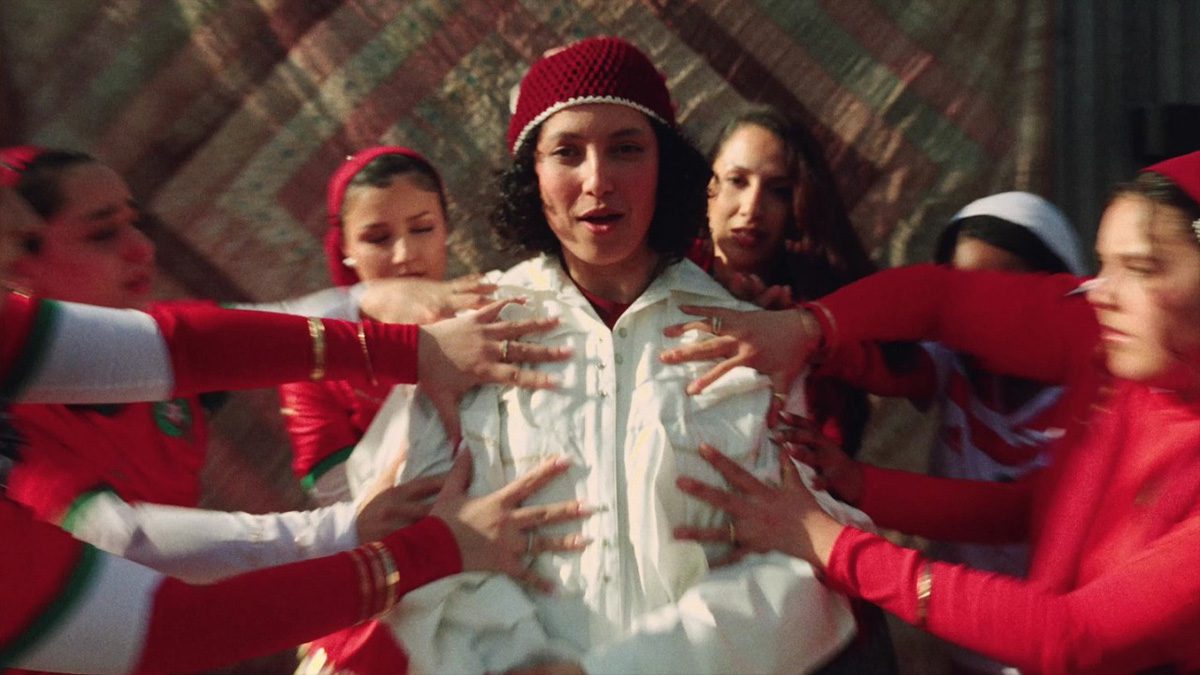
The visual, directed by DCR Prod, extends this identity with coherence and intention. Surrounded by dancers wearing the Moroccan national team jersey, Yasmine anchors her image within an aesthetic that is both cultural and contemporary. A recognized name in Belgium, DCR Prod has notably worked with Fresh and recently directed the latest visual by RA2B. The collective had also gained attention with the short film “P13, si j’avais”, a powerful and controversial piece written by ZEZ XXI.


